
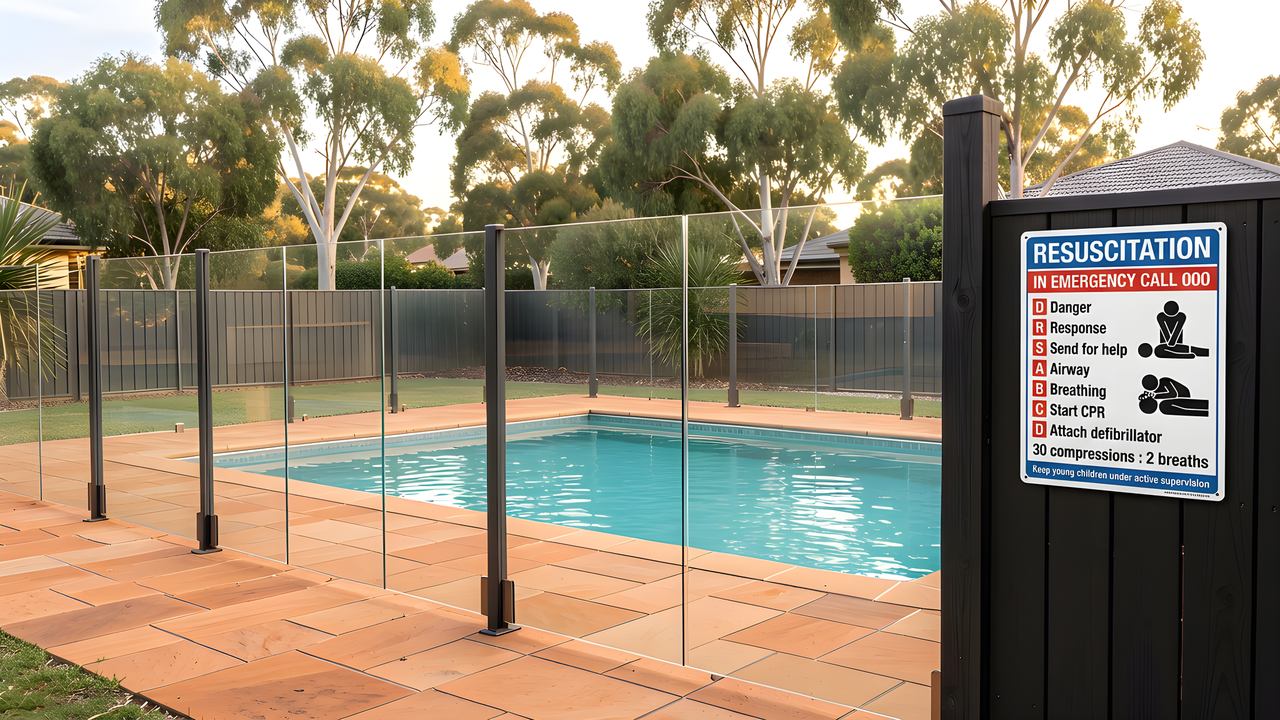
Signage is one of the smallest items a certifier assesses and one of the most commonly failed, which is a shame because it is also one of the easiest to get right.
A resuscitation sign is not a decorative nicety: it is there so that in the worst moment, someone standing at the poolside has the steps in front of them.
Here is exactly what a compliant sign has to show, where it goes, and why so many of them quietly stop complying.
Signage sits inside the wider assessment.
When I certify a pool I am looking at the fence design, the non-climbable areas, the gates and the way the pool meets the house and boundaries, and the resuscitation sign is part of that same picture, not a bolt-on.
But because it fails so often on its own, it is worth its own guide.
Key facts
- A resuscitation (CPR) sign must be displayed in the pool or spa area, in a prominent position, and kept legible.
- It must show current cardiopulmonary resuscitation (CPR) procedure consistent with the recognised guidelines (the DRSABCD approach).
- It must be durable and weather-resistant, and readable from a reasonable distance.
- Faded, outdated or missing signs are one of the most common inspection fails, and one of the cheapest to fix.
- Signage is assessed as part of overall pool compliance, alongside the fence, gates and non-climbable design.
Do I need a CPR sign for my pool in NSW?
Yes. Under the NSW pool safety rules, a resuscitation sign must be displayed in the pool area for a swimming pool or spa.
It is a requirement in its own right, separate from the fence, and it is checked at every compliance assessment.
There is no exemption for a private backyard pool: if you have a pool or spa that must comply, you must display a compliant resuscitation sign.
What does a compliant CPR sign have to show?
A compliant sign shows current CPR procedure, set out clearly enough that someone under pressure can follow it.
In practice that means the recognised resuscitation sequence, commonly summarised as DRSABCD: Danger, Response, Send for help, Airway, Breathing, CPR, Defibrillation.
The sign should present these as a clear, legible flow that a person can read and act on, and it needs to reflect the current guidance rather than a superseded version.
The reason "current" matters is that resuscitation guidance is periodically updated. A sign that was compliant a decade ago may show an out-of-date sequence, which is one of the ways an otherwise fine-looking sign fails.
If your sign is old, it is worth replacing it with a current one rather than assuming it still qualifies.
Where does the sign have to go?
In a prominent position in the pool or spa area, where it can be seen and read easily by someone at the poolside, and kept unobstructed.
The whole point is immediacy: it should be visible at the moment it is needed, not tucked behind a shed or inside a pool pump enclosure.
Mounting it on the inside of the fence or on a nearby wall, at a readable height and clear of clutter, is the usual approach.
Why do CPR signs fail inspection so often?
For a handful of very ordinary reasons.
The most common is fading. These signs live outdoors in full sun and pool chemistry, and a cheap or ageing sign bleaches until the text and diagrams are no longer clearly legible. A sign you can barely read does not do its job and does not pass.
The next is being out of date, showing an older resuscitation sequence than the current guidance.
Then there is the simple case of a missing sign: taken down during painting or landscaping and never put back, or never installed at all.
And occasionally a sign is present and current but hung somewhere it cannot readily be seen, which defeats the purpose.
All of these are among the quickest fixes in the whole compliance picture, which is why a faded or missing sign appears in the common inspection fails. When I find one at an assessment, supplying and mounting a compliant sign is exactly the kind of thing I sort during the visit so it does not cost you a second trip.
Is a CPR sign the same as a warning sign?
Not quite. The resuscitation sign is the main signage requirement people know.
Depending on the pool and its circumstances there can also be a role for warning or supervision signage, reminding users to supervise children and keep the gate closed.
The resuscitation sign is the one universally required in the pool area, and it is the one that most often decides the signage part of an assessment.
If your situation calls for any additional signage, I will tell you at the assessment.
How do I make sure my signage stays compliant?
Signage is a "set it and check it" item. Buy a good-quality, UV-stable and weatherproof sign rather than the cheapest one, because the cheap ones fade fastest.
Mount it somewhere prominent and unobstructed in the pool area. Then glance at it once a season: can you read it clearly from a few steps away, and does it show current guidance.
If the answer to either is no, replace it. A current, legible resuscitation sign is one of the least expensive parts of keeping a pool compliant, and there is no reason to lose an inspection over it.
Frequently asked questions
Do I legally need a CPR sign for a backyard pool in NSW?
Yes. A resuscitation sign must be displayed in the pool or spa area. There is no exemption for private backyard pools.
What must a compliant pool CPR sign show?
Current CPR procedure, commonly the DRSABCD sequence, presented clearly and legibly, reflecting the current resuscitation guidance rather than a superseded version.
Where should the CPR sign be placed?
In a prominent, unobstructed position in the pool area where someone at the poolside can read it immediately, such as on the inside of the fence or a nearby wall.
Why did my pool fail on the CPR sign?
Almost always because the sign has faded and is no longer clearly legible, shows out-of-date guidance, is missing, or is hung where it cannot readily be seen. All are quick to fix.
Can the certifier supply a compliant sign during the inspection?
Yes. A faded or missing sign is a minor item we can usually sort on the day, supplying and mounting a compliant sign rather than sending you back for a second visit.
Sources
- Swimming Pools Regulation 2018 (NSW): https://legislation.nsw.gov.au
- NSW Swimming Pool Register, pool safety information: https://www.swimmingpoolregister.nsw.gov.au/information
- NSW Government, Owning a pool or spa: your obligations: https://www.nsw.gov.au/housing-and-construction/building-or-renovating-a-home/pools-and-pool-safety/owner-obligations
Last reviewed 22/07/2026. This is practical information from a registered certifier, not legal advice.