
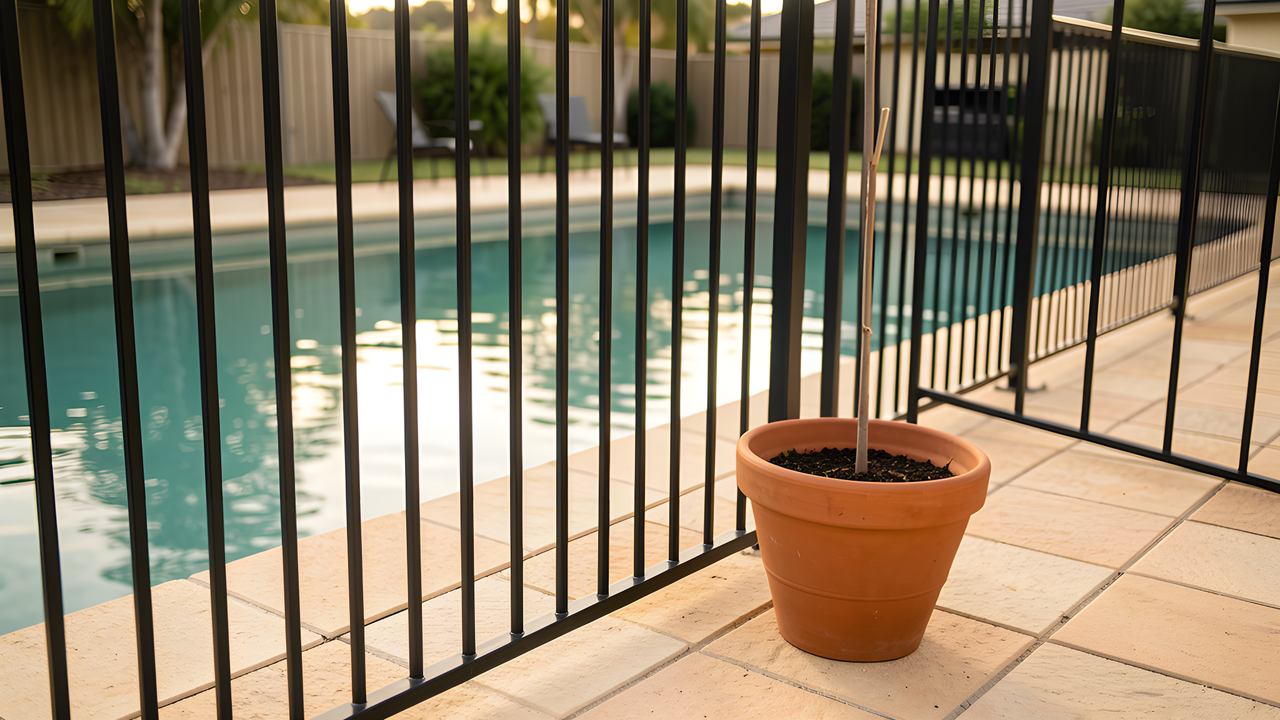
A certifier assesses your whole pool, the fence design, the non-climbable areas, the gates and hardware, the signage, and how the pool meets your house and boundaries.
But after enough of those assessments you notice that pools fall short for the same handful of reasons, over and over. Almost none of them are structural.
Most are small, and a good number can be sorted during the visit so you are not left guessing what happens next.
Here are the ten I see most, why each happens, and whether it is a five-minute fix or a bigger job, so you can clear the easy ones yourself before I arrive.
The whole point of reading this is that it is a checklist you can walk with a cup of coffee. Every measurement below is explained in full in the fence and barrier rules guide.
Key facts
- The most common fails are maintenance and clutter, not construction: gate hardware, footholds near the fence, and gaps that open up over time.
- Most of these we can sort out how to put right on the day (gate hinges and latches, minor adjustments, a replacement CPR sign), rather than turn into a second visit.
- A few (raising a boundary fence, replacing a section of fence) are referrals, not same-visit fixes, which is why inspecting early matters.
- You can clear most of the easy ones yourself before the inspection.
| Fault | DIY before I arrive? | Often sorted on the day? | Usually a trade referral? |
|---|---|---|---|
| Gate does not self-close | Leave unless you know the hardware | Yes | Rarely |
| Latch does not catch every time | Leave unless you know the hardware | Yes | Rarely |
| Climbable objects in the NCZ | Yes: clear 900mm outside | Yes if still present | No |
| Gap under the fence | Yes: check after rain | Sometimes if small | If ground needs real work |
| Gaps or damaged panels | Note them | Single panel sometimes | Whole runs usually |
| Faded or missing CPR sign | Yes if you already have a compliant sign | Yes | No |
| Climbable fence features | Remove add-ons if easy | Depends | Often fence modification |
| Boundary fence too low or climbable | Do not DIY raise a shared boundary | No | Yes |
| Doors or windows into the pool area | Do not assume a simple lock is enough | Depends on layout and age | Sometimes larger work |
| Not registered / certificate lapsed | Register free online first | Registration is separate from the visit | No |
1. A gate that does not self-close from every position
This is the number one fail, full stop. The gate has to swing shut and latch on its own from any position, including from resting just barely open.
Hinges lose tension over time, or someone adjusts them because the gate was slamming, and now it closes from wide open but not from a few centimetres ajar, which is exactly the gap a child slips through.
Usually a hinge adjustment or replacement. This is a classic on-the-spot fix.
2. A latch that does not catch every time
Right behind the gate itself is the latch that only sometimes engages. The gate looks shut but is not actually latched.
It is caused by misalignment, wear, or a latch mounted too low. The release also has to be at least 1.5 metres off the ground so a child cannot reach it.
Adjusting or replacing a latch is normally a same-visit fix.
3. Climbable objects inside the non-climbable zone
The fence is fine. It is the pot plant, BBQ, pool pump, planter box, outdoor setting, kids' cubby or firewood stack sitting within 900 millimetres of it that fails you, because it gives a child a foothold.
This is the easiest fail to fix yourself: walk the outside of the fence and clear a 900 millimetre space of anything a toddler could climb.
Do this before I arrive and you have eliminated one of the most common problems for free.
4. A gap under the fence that has opened up
Ground moves. Soil settles, garden beds erode, mulch washes away after rain, and a gap that was compliant two years ago is now wider than the 100 millimetre limit.
It is easy to miss because nobody touched the fence. Small gaps can sometimes be packed or a plinth added; larger movement needs proper attention.
Worth checking after heavy weather.
5. Gaps between the bars, or a damaged panel
Any gap wider than 100 millimetres fails, whether it is the original spacing on an older fence or a bar that has been bent, broken or removed.
On tubular and glass fences it is usually a damaged section rather than the original design. A single panel repair is often quick; a whole run is a larger job.
6. A faded, outdated or missing resuscitation sign
The CPR sign has to be present in the pool area and legible, showing current resuscitation guidance.
Signs fade in the sun, get taken down during painting and never go back up, or show guidance that has since been updated.
This is one of the cheapest fails to fix, and I can supply and mount a compliant sign during the visit. Details in the CPR signage guide.
7. Something climbable built into the fence itself
Horizontal rails on the outside of the fence within the climbable zone, lattice, decorative features, or a retaining wall that meets the fence can all turn the fence into a ladder.
This one is less about clutter and more about how the fence was built or what has been added to it. Depending on the feature, the fix ranges from removing an add-on to modifying the fence.
8. Boundary fence too low, or climbable from next door
Where a boundary fence forms part of the pool fence it has to be at least 1.8 metres high, and the non-climbable rules still apply on your side.
A standard 1.8 metre timber fence is often fine, but a lower Colorbond fence, or one with exposed rails and structure on your side, can fail.
Raising or modifying a boundary fence is a referral, not a same-visit fix, so it is exactly the kind of thing you want found early.
9. Doors or windows giving direct access to the pool area
On older properties where part of the house forms the pool enclosure, a door or window that opens straight into the pool area can be treated as part of the enclosure and has to be secured against child access. Whether this is a simple fix or a real project depends on the layout and the pool's age, which is why it is worth a certifier's eye before you assume anything.
10. The pool is not registered, or the certificate has lapsed
Not a fence fault, but it stops everything else.
If the pool is not on the NSW Swimming Pool Register, or you are relying on a certificate that is past its three-year life, you are not compliant on paper regardless of how good the fence is.
Registration is free and takes minutes. Sort it first so the inspection is the only thing left to do.
Which of these can I fix myself before the inspection?
Plenty of them. Clearing the 900 millimetre non-climbable zone (number three) costs nothing and takes ten minutes.
Checking and clearing the under-fence gap (number four) after rain is easy. Making sure the CPR sign is present and legible (number six), and registering the pool (number ten), are both quick.
The gate and latch faults (numbers one and two) are the ones people try to fix and often make worse by winding hinges the wrong way, so if in doubt, leave those for me: adjusting gate hardware correctly is fast when you know the target, and it is the fix I do most.
Frequently asked questions
What is the most common reason pools fail inspection in NSW?
Gates that do not self-close and self-latch from every position. It is a hardware maintenance issue, not a construction one, and it is usually a quick fix.
Can I fix pool compliance issues myself before the inspection?
Yes, several: clear anything climbable within 900 millimetres of the fence, check the gap under the fence, make sure the CPR sign is present and legible, and register the pool. Gate and latch adjustments are best left to the inspection.
Will a small fault mean a second inspection and a second fee?
Not with me for the common minor faults. Most small faults, we can sort out how to put right on the day, rather than turn into a second visit. Larger items, like raising a boundary fence, are a referral.
How long does it take to fix a failed gate latch?
Usually minutes. Most latch and hinge faults are adjustment or a straightforward replacement, which is why they are classic on-the-day items rather than reasons to leave you with a vague list.
My pool passed three years ago. Why would it fail now?
Because compliance is physical, not just paperwork. Gate hardware wears, ground erodes and opens gaps, and objects get moved near the fence. A fence drifts out of compliance quietly between certificates.
Sources
- NSW Swimming Pool Register, pool safety information and checklists: https://www.swimmingpoolregister.nsw.gov.au/information
- Swimming Pools Act 1992 (NSW) and Swimming Pools Regulation 2018 (NSW): https://legislation.nsw.gov.au
- Standard AS 1926.1-2012, Swimming pool safety: Safety barriers for swimming pools
Last reviewed 22/07/2026. This is practical information from a registered certifier, not legal advice.