
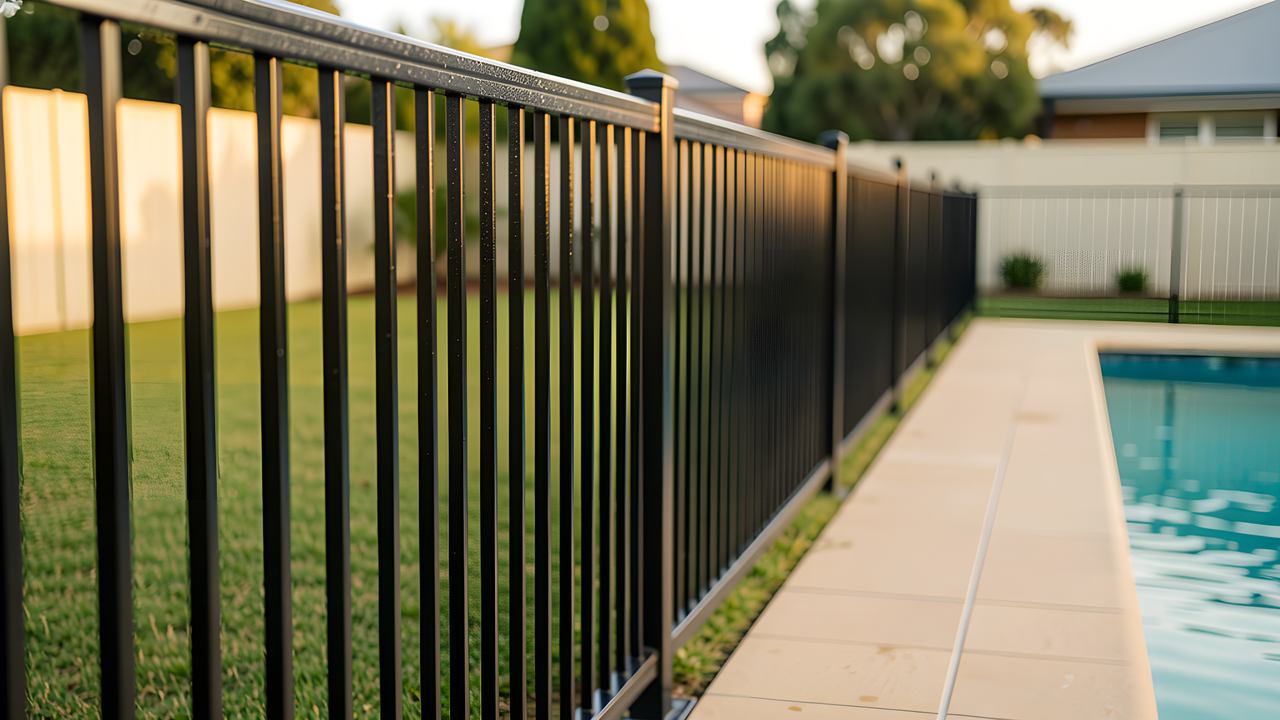
Nearly every fence rule in NSW exists to answer one question: can a young child who is not being watched get from the backyard to the water on their own.
If you keep that in mind, the numbers stop feeling arbitrary and start making sense. Here is every rule that applies to your fence, what the measurement is, and why it is there.
The measurements below come from the fence standard AS 1926.1-2012 and the Swimming Pools Regulation.
The fence is one part of what a certifier assesses (the full picture is in the complete compliance guide), but it is where most of the detail sits, and these are the same rules I assess against when I certify a pool.
So you can walk your own barrier with a tape measure before you book anything.
Key facts: the numbers that matter
- Fence height: at least 1200mm (1.2m) measured from the finished ground level on the outside.
- Gaps: no more than 100mm under the fence and no more than 100mm between vertical bars.
- Non-climbable zone: a 900mm clear arc on the outside of the fence with no footholds, and 300mm clear on the inside.
- Gate: self-closing from any position, self-latching, must swing outward away from the pool, latch release at least 1500mm (1.5m) above ground.
- Boundary fence used as part of the barrier: at least 1800mm (1.8m) high.
- A resuscitation sign must be displayed in the pool area.
How high does a pool fence have to be in NSW?
The fence must be at least 1.2 metres high, measured from the finished ground level on the outside of the fence to the top of the fence.
"Finished ground level" matters: if there is a garden bed, retaining wall, step or mound of mulch on the outside that a child could stand on, the effective height is measured from there, not from the lowest point.
I see fences that are a genuine 1.2 metres over lawn but only a metre above a raised garden bed a step away. That fails, and correctly so.
What is the maximum gap under and through a pool fence?
No gap in the fence can be larger than 100 millimetres. That applies to the space under the bottom rail and to the gaps between vertical bars. The 100 millimetre figure is about a small child's head and shoulders: anything wider and a toddler can get through or under.
The gap under the fence is the one that changes over time without anyone touching the fence. Ground erodes, soil settles, a garden bed washes away, and suddenly there is a 130 millimetre gap under a rail that was fine two years ago. It is worth checking after heavy rain.
What is the non-climbable zone?
This is the rule people understand least and fail most, so it is worth slowing down on.
A child can climb. So the standard requires a "non-climbable zone" (NCZ): a clear space where there is nothing to use as a foothold or handhold.
On the outside of the fence, that zone is a 900 millimetre arc measured from the top of the fence.
Within that arc there must be nothing climbable: no horizontal rails on the outside, no pot plants, no BBQ, no pool pump housing, no retaining wall, no tree branch, no outdoor furniture, no children's play equipment.
On the inside of the fence, a 300 millimetre clear zone applies near the top.
The reason so many pools fail here is that the fence itself is fine. It is what people put next to it that creates the foothold.
A single terracotta pot moved against the fence to make room for a party can turn a compliant barrier into a climbable one.
This is also the rule that quietly breaks compliance between certificates, which is why I mention it in the common fails guide and why it shapes so much of designing a pool that stays compliant.
What are the rules for pool gates and latches?
The gate is the part of the fence a person actually uses, so it has the most rules, and it is where I do the most on-the-spot fixing.
A compliant gate must swing outward, away from the pool. It must be self-closing from any position, including from resting just slightly open, without anyone pushing it.
It must self-latch every time it closes, so there is never a moment where it looks shut but is not. The latch release must be at least 1.5 metres above the ground, or otherwise shielded, so a small child cannot reach it.
And the gate must never be propped open.
Gates fail for ordinary, fixable reasons: a hinge that has lost its tension and no longer swings the gate closed, a latch that has dropped out of alignment so it catches only sometimes, or a self-closing hinge that someone wound off because the gate was slamming. A worn hinge or a misaligned latch is exactly the kind of thing I adjust or replace during the inspection rather than failing you and leaving.
Can my boundary fence be part of the pool fence?
Yes, a boundary fence can form part of the pool fence, but a higher rule applies: where a boundary fence is used as part of the barrier it must be at least 1.8 metres high.
The logic is that a boundary fence often has structure, a neighbour's shed, a garden, or objects on the far side that a certifier cannot see or control, so the extra height compensates.
The non-climbable zone still applies on your side.
One important NSW point: the wall of an above-ground pool is not permitted to act as the fence on its own. If you have an above-ground pool, it still needs a compliant barrier and a compliant means of access.
What about doors and windows that open into the pool area?
Older properties sometimes have a door or window from the house opening directly into the pool enclosure, or the house wall forming part of the barrier.
This is one of the more complex areas and depends heavily on when the pool was built and how the fence is arranged.
In general, doors and windows that give direct access to the pool area are treated as part of the barrier and have to be secured so a child cannot use them to reach the water.
If your pool area is bounded by part of the house, it is worth having a certifier look before you assume it is fine, because the fix is sometimes simple and sometimes not.
Do I need a resuscitation sign?
Yes. A resuscitation sign showing current CPR (cardiopulmonary resuscitation) procedure must be displayed in the pool area, positioned so it is easy to read, and kept legible.
It is a small item that fails a lot, usually because an older sign has faded or the guidance it shows is out of date. I cover exactly what a current sign has to show in the CPR signage guide.
Which edition of the standard applies to me?
The measurements above reflect AS 1926.1-2012, the current standard.
Pools built earlier are generally assessed against the edition that applied when they were built, and the NSW Swimming Pool Register provides date-based checklists for that purpose.
The practical reality is that the core numbers (1.2 metre height, 100 millimetre gaps, the non-climbable zone, a self-closing self-latching gate) are consistent enough across editions that a well-maintained fence tends to satisfy the checklist that applies to it.
If you want to know what the 2024 edition changes for future work, I keep a separate page on that.
Frequently asked questions
How high does a pool fence have to be in NSW?
At least 1.2 metres, measured from the finished ground level on the outside. If a boundary fence forms part of the barrier, it must be at least 1.8 metres.
How big can the gap under a pool fence be?
No more than 100 millimetres, and the same limit applies between vertical bars. Check the under-fence gap after heavy rain, because ground movement is the usual cause.
What is the 900mm non-climbable zone?
A clear arc on the outside of the fence, measured from the top, that must contain nothing a child could climb: no rails, plants, furniture, pumps or structures. It is the most commonly failed rule.
Which way should a pool gate open?
Outward, away from the pool. It must also close and latch by itself from any position, with the latch at least 1.5 metres off the ground.
Can I use my house wall or a glass door as the pool fence?
Sometimes, depending on the pool's age and layout, but doors and windows that open into the pool area must be secured against child access. Have a certifier assess it rather than guessing, because this is one of the trickier areas.
Sources
- Swimming Pools Act 1992 (NSW) and Swimming Pools Regulation 2018 (NSW): https://legislation.nsw.gov.au
- NSW Swimming Pool Register, pool safety information and checklists: https://www.swimmingpoolregister.nsw.gov.au/information
- NSW Government, Owning a pool or spa: your obligations: https://www.nsw.gov.au/housing-and-construction/building-or-renovating-a-home/pools-and-pool-safety/owner-obligations
- Standard AS 1926.1-2012, Swimming pool safety: Safety barriers for swimming pools
Last reviewed 22/07/2026. This is practical information from a registered certifier, not legal advice.